
SYSTEMATIC REVIEW
Efficacy and safety of bivalirudin and heparin with or without glycoprotein IIb/IIIa inhibitors in patients of acute coronary syndrome undergoing percutaneous coronary intervention: a systematic review and network meta-analysis
1
Department of Medicine, Gujranwala Medical College, Gujranwala, Pakistan
2
Department of Internal Medicine, Hospital Corporation of America (HCA), Houston Kingwood/University of Houston College of Medicine, Houston, USA
3
Department of Hospital Medicine, Guthrie Medical Group, Cortland, NY, USA
4
Wah Medical College, Pakistan
5
Department of Medicine, Springfield Regional Center, Springfield, OH, USA
6
Department of Medicine, Rawalpindi Medical University, Rawalpindi, Pakistan
7
Augusta University Cardiology Center, Augusta, Georgia, USA
8
Ascension St. Thomas Hospital, University of Tennessee, Nashville, TN, USA
9
Wayne State University, Detroit Medical Center, Cardiovascular Institute, Detroit, MI, USA
Submission date: 2025-09-22
Final revision date: 2026-01-18
Acceptance date: 2026-04-12
Publication date: 2026-06-19
Corresponding author
M Chadi Alraies
Wayne State University Detroit Medical Center Cardiovascular Institute Heart Hospital 311 Mack Ave Detroit, MI 48201, USA Phone: (216) 255-0008
Wayne State University Detroit Medical Center Cardiovascular Institute Heart Hospital 311 Mack Ave Detroit, MI 48201, USA Phone: (216) 255-0008
Arch Med Sci Atheroscler Dis 2026;11(1):87-101
KEYWORDS
TOPICS
ABSTRACT
Introduction:
Recent clinical trials have revealed that bivalirudin has comparable efficacy to heparin. In this network meta-analysis, we aimed to compare the efficacy and safety of bivalirudin and heparin administered as monotherapy or with glycoprotein IIb/IIIa inhibitors, in patients of acute coronary syndromes undergoing percutaneous coronary intervention (PCI).
Material and methods:
We performed a systematic search of PubMed and Embase to identify studies with acute coronary syndrome patients > 18 years, who underwent PCI, and were treated with bivalirudin or heparin either as monotherapy or with glycoprotein IIb/IIIa inhibitors. Outcomes were major bleeding, major adverse cardiovascular events (MACE), all-cause mortality, reinfarction, stent thrombosis and cardiovascular death. Pooled relative risks (RR) were calculated using the net-meta module with/and random effects model with a 95% confidence interval (CI) for statistical significance. Higgins I2 statistic was used to assess heterogeneity.
Results:
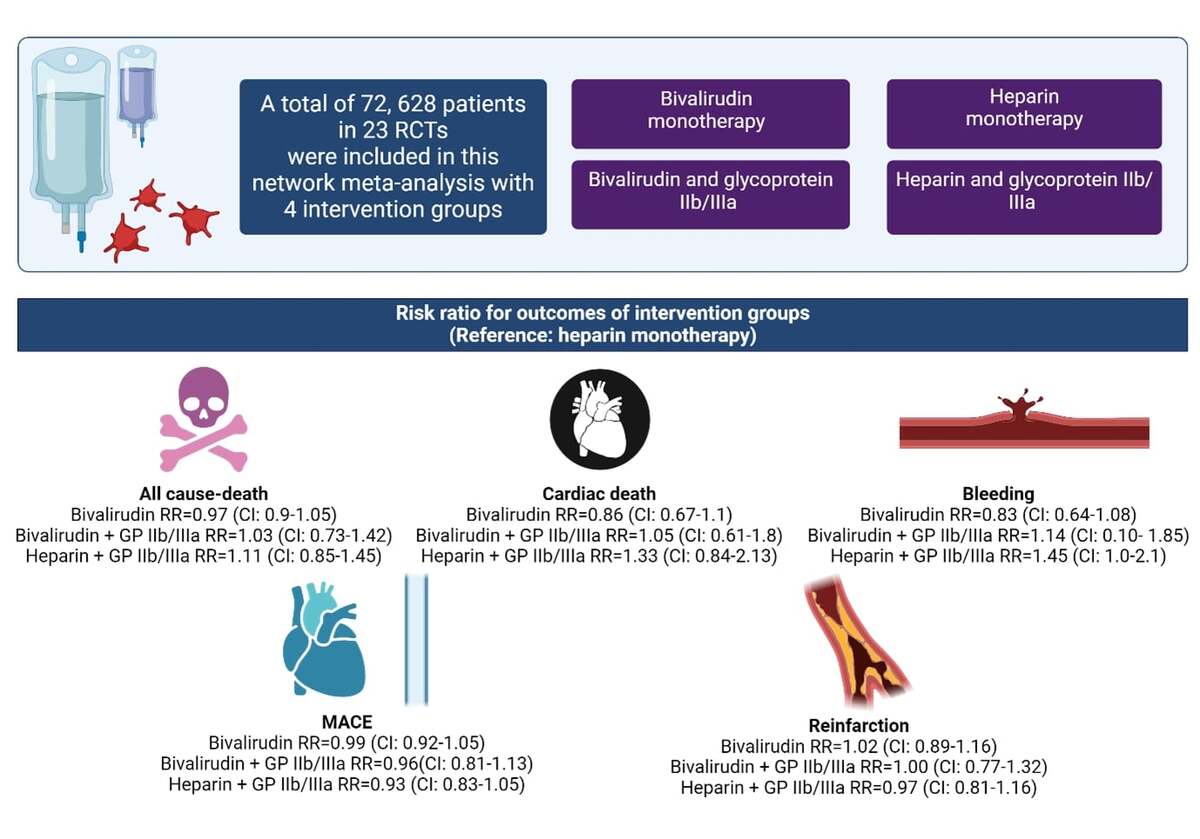
A total of 23 randomized controlled trials comprising 72,628 patients were included. Bivalirudin monotherapy compared to heparin monotherapy demonstrated no significant difference in risk of bleeding (RR = 0.83, 95% CI: 0.64–1.08, p = 0.17), MACE (RR = 0.99, 95% CI: 0.93–1.05, p = 0.72) and other outcomes. Bivalirudin combined with GP IIb/IIIa inhibitors had an increased risk of stent thrombosis compared with heparin monotherapy (RR = 3.62, 95% CI: 1.002–13.14). In major bleeding, heparin with GP IIb/IIIa inhibitors had a statistically significant RR of 1.454 (95% CI: 1.006–2.1009, p = 0.045).
Conclusions:
Bivalirudin and heparin have similar efficacy and safety profiles in patients undergoing PCI for ACS. The choice of the anticoagulant should be individualized based on patient and procedural characteristics.
Recent clinical trials have revealed that bivalirudin has comparable efficacy to heparin. In this network meta-analysis, we aimed to compare the efficacy and safety of bivalirudin and heparin administered as monotherapy or with glycoprotein IIb/IIIa inhibitors, in patients of acute coronary syndromes undergoing percutaneous coronary intervention (PCI).
Material and methods:
We performed a systematic search of PubMed and Embase to identify studies with acute coronary syndrome patients > 18 years, who underwent PCI, and were treated with bivalirudin or heparin either as monotherapy or with glycoprotein IIb/IIIa inhibitors. Outcomes were major bleeding, major adverse cardiovascular events (MACE), all-cause mortality, reinfarction, stent thrombosis and cardiovascular death. Pooled relative risks (RR) were calculated using the net-meta module with/and random effects model with a 95% confidence interval (CI) for statistical significance. Higgins I2 statistic was used to assess heterogeneity.
Results:
A total of 23 randomized controlled trials comprising 72,628 patients were included. Bivalirudin monotherapy compared to heparin monotherapy demonstrated no significant difference in risk of bleeding (RR = 0.83, 95% CI: 0.64–1.08, p = 0.17), MACE (RR = 0.99, 95% CI: 0.93–1.05, p = 0.72) and other outcomes. Bivalirudin combined with GP IIb/IIIa inhibitors had an increased risk of stent thrombosis compared with heparin monotherapy (RR = 3.62, 95% CI: 1.002–13.14). In major bleeding, heparin with GP IIb/IIIa inhibitors had a statistically significant RR of 1.454 (95% CI: 1.006–2.1009, p = 0.045).
Conclusions:
Bivalirudin and heparin have similar efficacy and safety profiles in patients undergoing PCI for ACS. The choice of the anticoagulant should be individualized based on patient and procedural characteristics.
REFERENCES (43)
1.
Mensah GA, Fuster V, Murray CJL, Roth GA; Global Burden of Cardiovascular Diseases and Risks Collaborators. Global burden of cardiovascular diseases and risks, 1990-2022. J Am Coll Cardiol 2023; 82: 2350-473.
2.
Rohani C, Jafarpoor H, Mortazavi Y, Esbakian B, Gholinia H. Mortality in patients with myocardial infarction and potential risk factors: a five-year data analysis. ARYA Atheroscler 2022; 18: 1-8.
3.
Manimekalai K. Deep learning methods in classification of myocardial infarction by employing ECG signals. Indian Soc Educ Environ 2020; 13: 2823-32.
4.
Patel I, Davidson J, Nikolic B, et al. Consensus guidelines for periprocedural management of coagulation status and hemostasis risk in percutaneous image-guided interventions. J Vasc Interv Radiol 2012; 23: 727-36.
5.
Matar F, Donoghue C, Rossi P, et al. Angiographic and clinical outcomes of bivalirudin versus heparin in patients with acute coronary syndrome undergoing percutaneous coronary intervention. Can J Cardiol 2006; 22: 1139-45.
6.
Jackson D, White IR, Riley RD. A matrix-based method of moments for fitting the multivariate random effects model for meta-analysis and meta-regression. Biometr J 2013; 55: 231-45.
7.
Efthimiou O, Rücker G, Schwarzer G, Higgins JP, Egger M, Salanti G. Network meta-analysis of rare events using the Mantel-Haenszel method. Statist Med 2019; 38: 2992-3012.
8.
Salanti G, Ades AE, Ioannidis JP. Graphical methods and numerical summaries for presenting results from multiple-treatment meta-analysis: an overview and tutorial. J Clin Epidemiol 2011; 64: 163-71.
9.
Higgins JP, Altman DG, Gøtzsche PC, et al. The Cochrane Collaboration’s tool for assessing risk of bias in randomized trials. BMJ 2011; 343: d5928.
10.
Lincoff AM, Kleiman NS, Kottke-Marchant K, et al. Bivalirudin with planned or provisional abciximab versus low-dose heparin and abciximab during percutaneous coronary revascularization: results of the Comparison of Abciximab Complications with Hirulog for Ischemic Events Trial (CACHET). Am Heart J 2002; 143: 847-53.
11.
Hirulog, Investigators ERoO-T. Thrombin-specific anticoagulation with bivalirudin versus heparin in patients receiving fibrinolytic therapy for acute myocardial infarction: the HERO-2 randomised trial. Lancet 2001; 358: 1855-63.
12.
Antman EM, McCabe CH, Braunwald E; Investigators T. Bivalirudin as a replacement for unfractionated heparin in unstable angina/non-ST-elevation myocardial infarction: observations from the TIMI 8 trial. Am Heart J 2002; 143: 229-34.
13.
Lincoff AM, Bittl JA, Harrington RA, et al. Bivalirudin and provisional glycoprotein IIb/IIIa blockade compared with heparin and planned glycoprotein IIb/IIIa blockade during percutaneous coronary intervention: REPLACE-2 randomized trial. JAMA 2003; 289: 853-63.
14.
Waksman R, Bertrand O, Driesman M, et al. Bivalirudin versus unfractionated heparin during percutaneous coronary intervention in patients with non-st-segment elevation acute coronary syndrome initially treated with fondaparinux: results from an international, multicenter, randomized pilot study (SWITCH III). J Interv Cardiol 2013; 26: 107-13.
15.
Chu WW, Kuchulakanti PK, Wang B, et al. Bivalirudin versus unfractionated heparin in patients undergoing percutaneous coronary intervention after acute myocardial infarction. Cardiovasc Revasc Med 2006; 7: 132-5.
16.
Stone GW, McLaurin BT, Cox DA, et al. Bivalirudin for patients with acute coronary syndromes. N Engl J Med 2006; 355: 2203-16.
17.
van Geuns RJ, Sideris G, Van Royen N, et al. Bivalirudin infusion to reduce ventricular infarction: the open-label, randomised Bivalirudin Infusion for Ventricular InfArction Limitation (BIVAL) study. EuroIntervention 2017; 13: e540-8.
18.
Kastrati A, Neumann FJ, Mehilli J, et al. Bivalirudin versus unfractionated heparin during percutaneous coronary intervention. N Engl J Med 2008; 359: 688-96.
19.
Stone GW, Witzenbichler B, Guagliumi G, et al. Bivalirudin during primary PCI in acute myocardial infarction. N Engl J Med 2008; 358: 2218-30.
20.
Tavano D, Visconti G, D’Andrea D, et al. Comparison of bivalirudin monotherapy versus unfractionated heparin plus tirofiban in patients with diabetes mellitus undergoing elective percutaneous coronary intervention. Am J Cardiol 2009; 104: 1222-8.
21.
Kastrati A, Neumann FJ, Schulz S, et al. Abciximab and heparin versus bivalirudin for non–ST-elevation myocardial infarction. N Engl J Med 2011; 365: 1980-9.
22.
Deshpande NV, Pratiti R, Admane P, Mukherjee D, Mardikar HM. Safety and efficacy of bivalirudin with glycoprotein IIb/IIIa for high-risk percutaneous coronary intervention. Indian Heart J 2012; 64: 444-8.
23.
Xiang DC, Gu XL, Song YM, et al. Evaluation on the efficacy and safety of domestic bivalirudin during percutaneous coronary intervention. Chinese Med J 2013; 126: 3064-8.
24.
Schulz S, Richardt G, Laugwitz KL, et al. Prasugrel plus bivalirudin vs. clopidogrel plus heparin in patients with ST-segment elevation myocardial infarction. Eur Heart J 2014; 35: 2285-94.
25.
Feldman A, Suleiman K, Bushari L, et al. Bivalirudin versus unfractionated heparin during percutaneous coronary intervention in patients at high risk for bleeding. Int J Angiol 2014; 23: 227-32.
26.
Shahzad A, Kemp I, Mars C, et al. Unfractionated heparin versus bivalirudin in primary percutaneous coronary intervention (HEAT-PPCI): an open-label, single centre, randomised controlled trial. Lancet 2014; 384: 1849-58.
27.
Han Y, Guo J, Zheng Y, et al. Bivalirudin vs heparin with or without tirofiban during primary percutaneous coronary intervention in acute myocardial infarction: the BRIGHT randomized clinical trial. JAMA 2015; 313: 1336-46.
28.
Valgimigli M, Frigoli E, Leonardi S, et al. Bivalirudin or unfractionated heparin in acute coronary syndromes N Engl J Med 2015; 373: 997-1009.
29.
Erlinge D, Omerovic E, Fröbert O, et al. Bivalirudin versus heparin monotherapy in myocardial infarction. N Engl J Med 2017; 377: 1132-42.
30.
Wang Y, Zhao HW, Wang CF, et al. Efficacy and safety of bivalirudin during percutaneous coronary intervention in high-bleeding-risk elderly patients with chronic total occlusion: a prospective randomized controlled trial. Catheter Cardiovasc Interv 2019; 93(S1): 825-31.
31.
Faour A, Collins N, Williams T, et al. Reperfusion After Fibrinolytic Therapy (RAFT): an open-label, multi-centre, randomised controlled trial of bivalirudin versus heparin in rescue percutaneous coronary intervention. PLoS One 2021; 16: e0259148.
32.
Li Y, Liang Z, Qin L, et al. Bivalirudin plus a high-dose infusion versus heparin monotherapy in patients with ST-segment elevation myocardial infarction undergoing primary percutaneous coronary intervention: a randomised trial. Lancet 2022; 400: 1847-57.
33.
Berlioz BE, Patel P, Sanghavi DK. Bivalirudin. [Updated 2024 Feb 28]. In: StatPearls [Internet]. Treasure Island (FL): StatPearls Publishing; 2025 Jan-. Available from: https://www.ncbi.nlm.nih.gov/b....
34.
Shammas NW. Bivalirudin: pharmacology and clinical applications. Cardiovasc Drug Rev 2005; 23: 345-60.
35.
Mulloy B, Hogwood J, Gray E, Lever R, Page CP. Pharmacology of heparin and related drugs. Pharmacol Rev 2016; 68: 76-141.
36.
Joseph L, Casanegra AI, Dhariwal M, et al. Bivalirudin for the treatment of patients with confirmed or suspected heparin-induced thrombocytopenia. J Thromb Haemost 2014; 12: 1044-53.
37.
Wallentin L, Becker RC, Budaj A, et al. Ticagrelor versus clopidogrel in patients with acute coronary syndromes. N Engl J Med 2009; 361: 1045-57.
38.
Wiviott SD, Braunwald E, McCabe CH, et al. Prasugrel versus clopidogrel in patients with acute coronary syndromes. N Engl J Med 2007; 357: 2001-15.
39.
Cassese S, Byrne RA, Laugwitz KL, Schunkert H, Berger PB, Kastrati A. Bivalirudin versus heparin in patients treated with percutaneous coronary intervention: a meta-analysis of randomised trials. Eurointervention 2015; 11: 196-203.
40.
Maqsood MH, Yong CM, Rao SV, Cohen MG, Pancholy S, Bangalore S. Procedural outcomes with femoral, radial, distal radial, and ulnar access for coronary angiography: a network meta-analysis. Circ Cardiovasc Interv 2024; 17: e014186.
41.
Palmerini T, Kirtane AJ, Serruys PW, et al. Stent thrombosis with everolimus-eluting stents: meta-analysis of comparative randomized controlled trials. Circ Cardiovasc Interv 2012; 5: 357-64.
42.
Tummala R, Rai MP. Glycoprotein IIb/IIIa Inhibitors. [Updated 2023 Jul 25]. In: StatPearls [Internet]. Treasure Island (FL): StatPearls Publishing; 2025 Jan-. Available from: https://www.ncbi.nlm.nih.gov/b....
43.
Kini AS, Chen VH, Krishnan P, et al. Bolus-only versus bolus + infusion of glycoprotein IIb/IIIa inhibitors during percutaneous coronary intervention. Am Heart J 2008; 156: 513-9.
Share
RELATED ARTICLE
| eISSN: | 2451-0629 |

We process personal data collected when visiting the website. The function of obtaining information about users and their behavior is carried out by voluntarily entered information in forms and saving cookies in end devices. Data, including cookies, are used to provide services, improve the user experience and to analyze the traffic in accordance with the Privacy policy. Data are also collected and processed by Google Analytics tool (more).
You can change cookies settings in your browser. Restricted use of cookies in the browser configuration may affect some functionalities of the website.
You can change cookies settings in your browser. Restricted use of cookies in the browser configuration may affect some functionalities of the website.