
META-ANALYSIS
Colchicine’s promise in post-ablation atrial fibrillation: a meta-analysis
1
Department of Medicine, Gujranwala Medical College, Gujranwala, Pakistan
2
Department of Internal Medicine, Hospital Corporation of America (HCA) Houston Kingwood/University of Houston College of Medicine, Houston, USA
3
Department of Hospital Medicine, Guthrie Cortland Regional Medical Center, NY, USA
4
Department of Medicine, Rawalpindi Medical University, Rawalpindi, Pakistan
5
Department of Cardiology, Baylor College of Medicine, Houston, Texas, USA
6
Wayne State University, Detroit Medical Center, Cardiovascular Institute, Heart Hospital, Detroit, MI, USA
Submission date: 2025-12-20
Final revision date: 2026-05-18
Acceptance date: 2026-05-18
Publication date: 2026-07-09
Corresponding author
M Chadi Alraies
Wayne State University Cardiac Catheterization Laboratory Harper University Hospital/ Wayne State University Detroit Medical Center Cardiovascular Institute Heart Hospital 311 Mack Avenue Detroit, MI 48201 Phone: + 1 (216) 255-0008
Wayne State University Cardiac Catheterization Laboratory Harper University Hospital/ Wayne State University Detroit Medical Center Cardiovascular Institute Heart Hospital 311 Mack Avenue Detroit, MI 48201 Phone: + 1 (216) 255-0008
Arch Med Sci Atheroscler Dis 2026;11(1):159-166
KEYWORDS
TOPICS
ABSTRACT
Introduction:
Catheter ablation for restoration of sinus rhythm is limited by the high rates of arrhythmia due to inflammation caused by the procedure. Colchicine, a microtubule polymerisation inhibitor, reduces inflammation and may decrease atrial arrhythmia recurrence. We conducted a meta-analysis of RCTs and observational studies to assess the efficacy of colchicine in reducing atrial fibrillation (A fib) recurrence and pericarditis.
Methods:
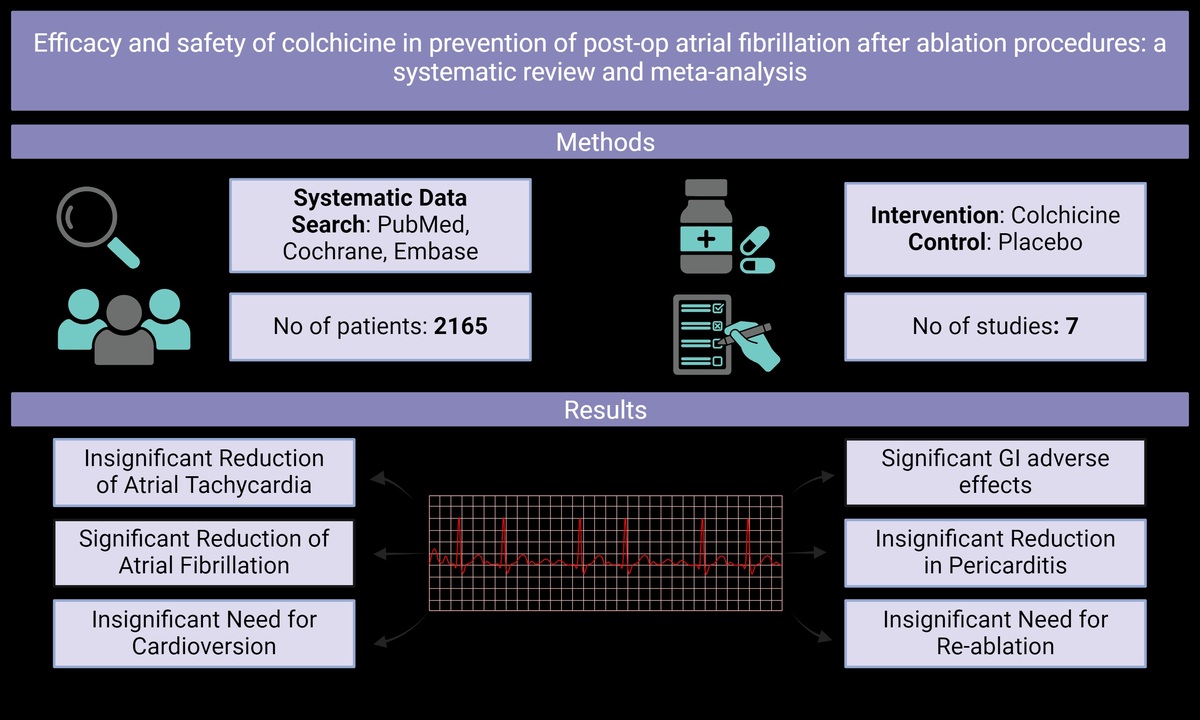
We identified seven studies through the systematic search of the PubMed, Embase, and Cochrane databases from inception to March 2024. Eligible articles had to be RCTs or observational studies comparing the effectiveness of colchicine with placebo in patients who underwent catheter ablation. Outcomes included A fib recurrence, atrial tachycardia, need to perform cardioversion or re-ablation, gastrointestinal (GI) adverse effects, pericarditis, and repeat hospitalisation. A random effects model was used to analyse binary outcomes, and the Mantel-Haenszel method was used to calculate the odds ratio with a 95% confidence interval.
Results:
Data from 2165 patients were analysed. Colchicine reduced A fib OR = 0.61 (p = 0.001), pericarditis OR = 0.54 (p = 0.07), and the need for re-ablation OR = 0.53 (p = 0.36). However, it increased GI adverse effects OR = 3.15 (p = 0.008). There was no statistical difference in the need for cardioversion, repeat hospitalisation, and atrial tachycardia between the two groups.
Conclusions:
Although colchicine significantly reduced the recurrence of A fib, further investigation is needed for a comprehensive understanding of the efficacy of colchicine in patients with catheter ablation.
Catheter ablation for restoration of sinus rhythm is limited by the high rates of arrhythmia due to inflammation caused by the procedure. Colchicine, a microtubule polymerisation inhibitor, reduces inflammation and may decrease atrial arrhythmia recurrence. We conducted a meta-analysis of RCTs and observational studies to assess the efficacy of colchicine in reducing atrial fibrillation (A fib) recurrence and pericarditis.
Methods:
We identified seven studies through the systematic search of the PubMed, Embase, and Cochrane databases from inception to March 2024. Eligible articles had to be RCTs or observational studies comparing the effectiveness of colchicine with placebo in patients who underwent catheter ablation. Outcomes included A fib recurrence, atrial tachycardia, need to perform cardioversion or re-ablation, gastrointestinal (GI) adverse effects, pericarditis, and repeat hospitalisation. A random effects model was used to analyse binary outcomes, and the Mantel-Haenszel method was used to calculate the odds ratio with a 95% confidence interval.
Results:
Data from 2165 patients were analysed. Colchicine reduced A fib OR = 0.61 (p = 0.001), pericarditis OR = 0.54 (p = 0.07), and the need for re-ablation OR = 0.53 (p = 0.36). However, it increased GI adverse effects OR = 3.15 (p = 0.008). There was no statistical difference in the need for cardioversion, repeat hospitalisation, and atrial tachycardia between the two groups.
Conclusions:
Although colchicine significantly reduced the recurrence of A fib, further investigation is needed for a comprehensive understanding of the efficacy of colchicine in patients with catheter ablation.
REFERENCES (18)
1.
Varghese B, Feldman DI, Chew C, et al. Inflammation, atrial fibrillation, and the potential role for colchicine therapy. Heart Rhythm O2 2021; 2: 298-303.
2.
Schnabel RB, Yin X, Gona P, et al. 50 year trends in atrial fibrillation prevalence, incidence, risk factors, and mortality in the Framingham Heart Study: a cohort study. Lancet 2015; 386: 154-62.
3.
January CT, Wann LS, Calkins H, et al. 2019 AHA/ACC/HRS focused update of the 2014 AHA/ACC/HRS guideline for the management of patients with atrial fibrillation: a report of the American College of Cardiology/American Heart Association Task Force on Clinical Practice Guidelines and the Heart Rhythm Society in collaboration with the Society of Thoracic Surgeons. Circulation 2019; 140: e125-51.
4.
Sterne JA, Savović J, Page MJ, et al. RoB 2: a revised tool for assessing risk of bias in randomised trials. BMJ 2019; 366: l4898.
5.
Benz AP, Amit G, Connolly SJ, et al. Colchicine to prevent atrial fibrillation recurrence after catheter ablation: a randomized, placebo-controlled trial. Circ Arrhythmia Electrophysiol 2024; 17: e01238.
6.
Ahmed AS, Miller J, Foreman J, et al. Prophylactic colchicine after radiofrequency ablation of atrial fibrillation: the PAPERS study. Clin Electrophysiol 2023; 9: 1060-6.
7.
Deftereos S, Giannopoulos G, Efremidis M, et al. Colchicine for prevention of atrial fibrillation recurrence after pulmonary vein isolation: mid-term efficacy and effect on quality of life. Heart Rhythm 2014; 11: 620-8.
8.
Deftereos S, Giannopoulos G, Kossyvakis C, et al. Colchicine for prevention of early atrial fibrillation recurrence after pulmonary vein isolation: a randomized controlled study. J Am Coll Cardiol 2012; 60: 1790-6.
9.
Mohanty S, Mohanty P, Kessler D, et al. Impact of colchicine monotherapy on the risk of acute pericarditis following atrial fibrillation ablation. Clin Electrophysiol 2023; 9: 1051-9.
10.
Campbell KB, Eickman SD, Truong T, et al. Colchicine for the prevention of recurrent arrhythmia after catheter ablation of atrial fibrillation: results of a single-center, retrospective study. Am J Cardiovasc Drugs 2023; 23: 709-19.
11.
Iqbal AM, Li KY, Gautam S. Colchicine usage for prevention of post atrial fibrillation ablation pericarditis in patients undergoing high-power short-duration ablation. J Cardiovasc Electrophysiol 2023; 34: 1370-6.
12.
Beyerbach DM, Zipes DP. Mortality as an endpoint in atrial fibrillation. Heart Rhythm 2004; 1: 8-19.
13.
Amaral NB, Rodrigues TS, Giannini MC, et al. Colchicine reduces the activation of NLRP3 inflammasome in COVID-19 patients. Inflamm Res 2023; 72: 895-9.
14.
Li Y, Zhang Y, Lu J, Yin Y, Xie J, Xu B. Anti-inflammatory mechanisms and research progress of colchicine in atherosclerotic therapy. J Cell Mol Med 2021; 25: 8087-94.
15.
Dasgeb B, Kornreich D, McGuinn K, Okon L, Brownell I, Sackett D. Colchicine: an ancient drug with novel applications. Br J Dermatol 2018; 178: 350-6.
16.
Pavelka M, Gangl A. Effects of colchicine on the intestinal transport of endogenous lipid: ultrastructural, biochemical, and radiochemical studies in fasting rats. Gastroenterology 1983; 84: 544-55.
17.
Zhan Y, Yue H, Zhao X, Tang J, Wu Z. Colchicine in atrial fibrillation: are old trees in bloom? Front Physiol 2023; 14: 1260774.
18.
Mustafa U, Dherange P, Reddy R, et al. Atrial fibrillation is associated with higher overall mortality in patients with implantable cardioverter-defibrillator: a systematic review and meta-analysis. J Am Heart Assoc 2018; 7: e010156.
Share
RELATED ARTICLE
| eISSN: | 2451-0629 |

We process personal data collected when visiting the website. The function of obtaining information about users and their behavior is carried out by voluntarily entered information in forms and saving cookies in end devices. Data, including cookies, are used to provide services, improve the user experience and to analyze the traffic in accordance with the Privacy policy. Data are also collected and processed by Google Analytics tool (more).
You can change cookies settings in your browser. Restricted use of cookies in the browser configuration may affect some functionalities of the website.
You can change cookies settings in your browser. Restricted use of cookies in the browser configuration may affect some functionalities of the website.