
META-ANALYSIS
Cerebral embolic protection in patients undergoing transcatheter aortic valve implantation: an updated meta-analysis of randomised controlled trials
1
The Rotherham NHS Foundation Trust, UK
2
Darent Valley Hospital, UK
3
Department of Cardiology Midland Metropolitan University Hospital UK
4
Department of Medicine, Addenbrooke’s Hospital, UK
5
Department of Medicine, South Tyneside District Hospital, UK
6
Department of Medicine, Sunderland Royal Hospital, UK
7
Cardiothoracic Department, Freeman Hospital, UK
8
Department of Cardiology, Sunderland Royal Hospital, UK
9
Department of Cardiology, Mid Yorkshire Hospitals NHS Trust, Wakefield, UK
10
RAK Medical and Health Sciences University, Ras Al Khaimah, UAE
11
Department of Cardiology, Sheikh Shakhbout Medical City, UAE
12
Department of Cardiology, William Harvey Hospital, UK
13
Department of Medicine, Worthing Hospital, UK
14
Department of Cardiology, Newcastle University, UK
15
Department of Cardiology, Royal Brompton Hospital, London, UK
Submission date: 2025-11-13
Final revision date: 2026-05-04
Acceptance date: 2026-05-20
Publication date: 2026-06-30
Arch Med Sci Atheroscler Dis 2026;11(1):149-158
KEYWORDS
TOPICS
ABSTRACT
Introduction:
Transcatheter aortic valve implantation (TAVI) has become a standard treatment for patients with severe aortic stenosis. However, periprocedural cerebral embolisation remains a major complication, contributing to the risk of stroke and silent cerebral infarctions. Cerebral embolic protection devices (CEPDs) have been developed to mitigate this risk, but their clinical efficacy remains uncertain.
Methods:
A systematic search of the PubMed/Medline, Embase, and Cochrane library databases was conducted for randomised controlled trials (RCTs) comparing CEPD use versus no CEPD in patients undergoing TAVI, from inception to 1 May 2025. The primary outcome was all-cause stroke. Risk ratios (RRs) and mean differences (MDs) were pooled using a random-effects model.
Results:
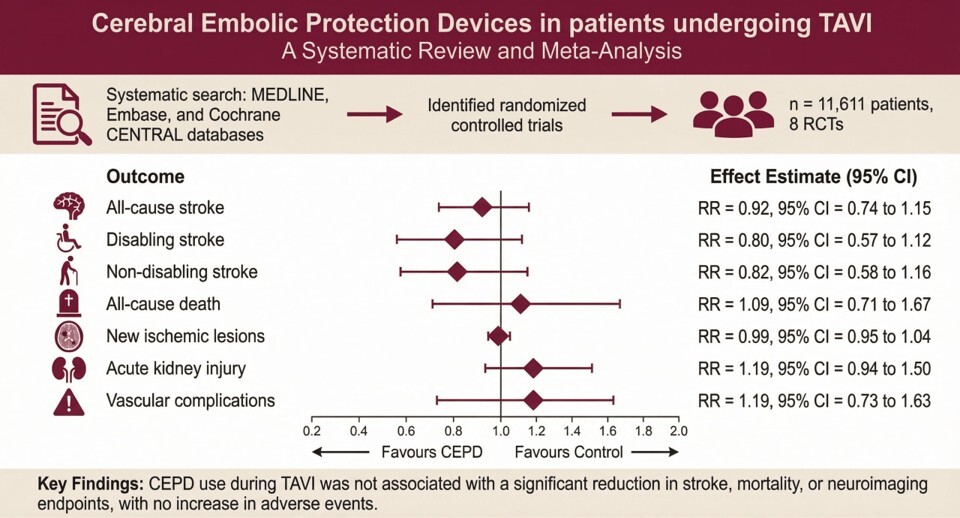
Eight RCTs comprising 11,611 patients (5956 with CEPD and 5655 without CEPD) were included. CEPD use was not associated with a significant reduction in all-cause stroke (RR = 0.92, 95% CI: 0.74–1.15), disabling stroke (RR = 0.80, 95% CI: 0.57–1.12), or non-disabling stroke (RR = 0.82, 95% CI: 0.58–1.16). No significant differences were observed in all-cause mortality (RR = 1.09, p = 0.70), NIHSS worsening (RR = 1.21, p = 0.41), new ischaemic lesions (RR = 0.99, p = 0.70), or lesion volume on DW-MRI (MD = –78.89 mm³, p = 0.10). Similarly, no significant differences were found in the incidence of acute kidney injury or vascular complications (p > 0.05).
Conclusions:
The use of CEPDs during TAVI was not associated with a reduction in stroke, mortality, or other adverse clinical outcomes. Further research may be needed to identify subgroups who could benefit from CEPD use.
Transcatheter aortic valve implantation (TAVI) has become a standard treatment for patients with severe aortic stenosis. However, periprocedural cerebral embolisation remains a major complication, contributing to the risk of stroke and silent cerebral infarctions. Cerebral embolic protection devices (CEPDs) have been developed to mitigate this risk, but their clinical efficacy remains uncertain.
Methods:
A systematic search of the PubMed/Medline, Embase, and Cochrane library databases was conducted for randomised controlled trials (RCTs) comparing CEPD use versus no CEPD in patients undergoing TAVI, from inception to 1 May 2025. The primary outcome was all-cause stroke. Risk ratios (RRs) and mean differences (MDs) were pooled using a random-effects model.
Results:
Eight RCTs comprising 11,611 patients (5956 with CEPD and 5655 without CEPD) were included. CEPD use was not associated with a significant reduction in all-cause stroke (RR = 0.92, 95% CI: 0.74–1.15), disabling stroke (RR = 0.80, 95% CI: 0.57–1.12), or non-disabling stroke (RR = 0.82, 95% CI: 0.58–1.16). No significant differences were observed in all-cause mortality (RR = 1.09, p = 0.70), NIHSS worsening (RR = 1.21, p = 0.41), new ischaemic lesions (RR = 0.99, p = 0.70), or lesion volume on DW-MRI (MD = –78.89 mm³, p = 0.10). Similarly, no significant differences were found in the incidence of acute kidney injury or vascular complications (p > 0.05).
Conclusions:
The use of CEPDs during TAVI was not associated with a reduction in stroke, mortality, or other adverse clinical outcomes. Further research may be needed to identify subgroups who could benefit from CEPD use.
REFERENCES (32)
1.
Athappan G, Gajulapalli RD, Tuzcu ME, Svensson LG, Kapadia SR. A systematic review on the safety of second-generation transcatheter aortic valves. EuroIntervention 2016; 11: 1034-43.
2.
Kapadia S, Agarwal S, Miller DC, et al. Insights into timing, risk factors, and outcomes of stroke and transient ischemic attack after transcatheter aortic valve replacement in the PARTNER Trial (Placement of Aortic Transcatheter Valves). Circ Cardiovasc Interv 2016; 9: e002981.
3.
Nombela-Franco L, Webb JG, de Jaegere PP, et al. Timing, predictive factors, and prognostic value of cerebrovascular events in a large cohort of patients undergoing transcatheter aortic valve implantation. Circulation 2012; 126: 3041-53.
4.
Nuis RJ, Van Mieghem NM, Schultz CJ, et al. Frequency and causes of stroke during or after transcatheter aortic valve implantation. Am J Cardiol 2012; 109: 1637-43.
5.
Daneault B, Kirtane AJ, Kodali SK, et al. Stroke associated with surgical and transcatheter treatment of aortic stenosis: a comprehensive review. J Am Coll Cardiol 2011; 58: 2143-50.
6.
Astarci P, Glineur D, Kefer J, et al. Magnetic resonance imaging evaluation of cerebral embolization during percutaneous aortic valve implantation: comparison of transfemoral and trans-apical approaches using Edwards Sapiens valve. Eur J Cardiothorac Surg 2011; 40: 475-9.
7.
Fairbairn TA, Mather AN, Bijsterveld P, et al. Diffusion-weighted MRI determined cerebral embolic infarction following transcatheter aortic valve implantation: assessment of predictive risk factors and the relationship to subsequent health status. Heart Br Card Soc 2012; 98: 18-23.
8.
Vlastra W, Vendrik J, Koch KT, Baan J, Piek JJ, Delewi R. Cerebral protection devices during transcatheter aortic valve implantation. Trends Cardiovasc Med 2018; 28: 412-8.
9.
Butala NM, Makkar R, Secemsky EA, et al. Cerebral embolic protection and outcomes of transcatheter aortic valve replacement: results from the transcatheter valve therapy registry. Circulation 2021; 143: 2229-40.
10.
Kapadia SR, Makkar R, Leon M, et al. Cerebral embolic protection during transcatheter aortic-valve replacement. N Engl J Med 2022; 387: 1253-63.
11.
Lansky AJ, Schofer J, Tchetche D, et al. A prospective randomized evaluation of the TriGuardTM HDH embolic DEFLECTion device during transcatheter aortic valve implantation: results from the DEFLECT III trial. Eur Heart J 2015; 36: 2070-8.
12.
Kharbanda RK, Kennedy J, Jamal Z, et al. Routine cerebral embolic protection during transcatheter aortic-valve implantation. N Engl J Med 2025; 392: 2403-12.
13.
Page MJ, McKenzie JE, Bossuyt PM, et al. The PRISMA 2020 statement: an updated guideline for reporting systematic reviews. BMJ 2021; 372: n71.
14.
Sterne JAC, Savović J, Page MJ, et al. RoB 2: a revised tool for assessing risk of bias in randomised trials. BMJ 2019; 366: l4898.
15.
DerSimonian R, Laird N. Meta-analysis in clinical trials. Control Clin Trials 1986; 7: 177-88.
16.
Haussig S, Mangner N, Dwyer MG, et al. Effect of a cerebral protection device on brain lesions following transcatheter aortic valve implantation in patients with severe aortic stenosis: the CLEAN-TAVI randomized clinical trial. JAMA 2016; 316: 592.
17.
Van Mieghem NM, Van Gils L, Ahmad H, et al. Filter-based cerebral embolic protection with transcatheter aortic valve implantation: the randomised MISTRAL-C trial. EuroIntervention 2016; 12: 499-507.
18.
Kapadia SR, Kodali S, Makkar R, et al. Protection against cerebral embolism during transcatheter aortic valve replacement. J Am Coll Cardiol 2017; 69: 367-77.
19.
Lansky AJ, Makkar R, Nazif T, et al. A randomized evaluation of the TriGuardTM HDH cerebral embolic protection device to Reduce the Impact of Cerebral Embolic LEsions after TransCatheter Aortic Valve ImplanTation: the REFLECT I trial. Eur Heart J 2021; 42: 2670-9.
20.
Nazif TM, Moses J, Sharma R, et al. Randomized evaluation of triguard 3 cerebral embolic protection after transcatheter aortic valve replacement. JACC Cardiovasc Interv 2021; 14: 515-27.
21.
Alkhouli M, Alqahtani F, Harris AH, Hohmann SF, Rihal CS. Early experience with cerebral embolic protection during transcatheter aortic valve replacement in the United States. JAMA Intern Med 2020; 180: 783-4.
22.
Basit J, Ahmed M, Kidess G, et al. Cerebral embolic protection for stroke prevention during transcatheter aortic valve replacement. Expert Rev Cardiovasc Ther 2024; 22: 409-20.
23.
Butala NM, Kapadia SR, Secemsky EA, et al. Impact of cerebral embolic protection devices on disabling stroke after TAVR: updated results from the STS/ACC TVT Registry. Circ Cardiovasc Interv 2024; 17: e013697.
24.
Carroll JD, Mack MJ, Vemulapalli S, et al. STS-ACC TVT Registry of transcatheter aortic valve replacement. J Am Coll Cardiol 2020; 76: 2492-516.
25.
Ahmad Y, Howard JP. Meta-analysis of usefulness of cerebral embolic protection during transcatheter aortic valve implantation. Am J Cardiol 2021; 146: 69-73.
26.
Aladin AI, Case BC, Wermers JP, Rogers T, Waksman R. Overview of FDA circulatory system devices panel virtual meeting on TriGUARD 3 cerebral embolic protection. Catheter Cardiovasc Interv 2022; 99: 1789-95.
27.
Ahmed M, Hashmi TM, Shafiq A, et al. Early intervention versus conservative management for asymptomatic severe aortic stenosis: an updated meta-analysis of randomized controlled trials. Cardiol Rev 2025 Apr 2. doi:10.1097/CRD.0000000000000910.
28.
Ahmed M, Ahsan A, Tabassum S, et al. Hemodynamic and clinical outcomes with balloon-expandable valves versus self-expanding valves in patients with small aortic annulus undergoing transcatheter aortic valve replacement: a meta-analysis of randomized controlled trials and propensity score matched studies. Int J Cardiol Heart Vasc 2024; 55: 101542.
29.
Ryan T, Grindal A, Jinah R, et al. New-onset atrial fibrillation after transcatheter aortic valve replacement: a systematic review and meta-analysis. JACC Cardiovasc Interv 2022; 15: 603-13.
30.
Cubero-Gallego H, Pascual I, Rozado J, et al. Cerebral protection devices for transcatheter aortic valve replacement. Ann Transl Med 2019; 7: 584.
31.
Pagnesi M, Martino EA, Chiarito M, et al. Silent cerebral injury after transcatheter aortic valve implantation and the preventive role of embolic protection devices: a systematic review and meta-analysis. Int J Cardiol 2016; 221: 97-106.
32.
Woldendorp K, Indja B, Bannon PG, Fanning JP, Plunkett BT, Grieve SM. Silent brain infarcts and early cognitive outcomes after transcatheter aortic valve implantation: a systematic review and meta-analysis. Eur Heart J 2021; 42: 1004-15.
Share
RELATED ARTICLE
| eISSN: | 2451-0629 |

We process personal data collected when visiting the website. The function of obtaining information about users and their behavior is carried out by voluntarily entered information in forms and saving cookies in end devices. Data, including cookies, are used to provide services, improve the user experience and to analyze the traffic in accordance with the Privacy policy. Data are also collected and processed by Google Analytics tool (more).
You can change cookies settings in your browser. Restricted use of cookies in the browser configuration may affect some functionalities of the website.
You can change cookies settings in your browser. Restricted use of cookies in the browser configuration may affect some functionalities of the website.