
STATE OF THE ART PAPER
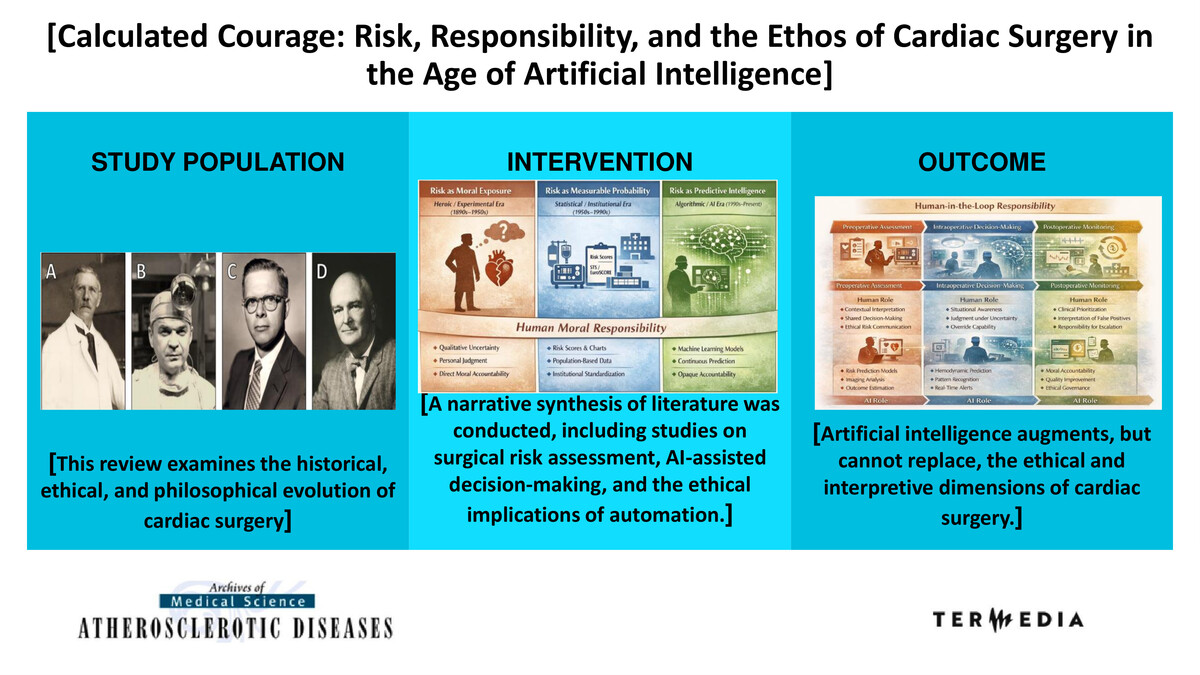
Calculated courage: risk, responsibility, and the ethos of cardiac surgery in the age of artificial intelligence
1
Department of Cardiothoracic and Vascular Surgery, Westpfalz Klinikum, Kaiserslautern, Germany
2
Department of Cardiothoracic Surgery, Faculty of Medicine, University of Thessaly, Biopolis, Larissa, Greece
3
Department of Cardiac Surgery, Ippokrateio General Hospital of Athens, Athens, Greece
4
Department of Electrical and Computer Engineering, Democritus University of Thrace, Xanthi, Greece
5
Department of Oncology, General University Hospital of Patras, Greece
6
John Radcliffe Hospital Emergency Department, University Hospitals NHS Foundation Trust, Headley Way, Headington, Oxford OX3 9DU, UK
7
Department of Vascular Surgery, General University Hospital of Patras, Greece
8
Department of Surgery, General Hospital of Eastern Achaia - Unit of Aigio, Greece
9
Medical School, National and Kapodistrian University of Athens (NKUA), Aretaeion Hospital, Athens, Greece
10
Department of Surgery, General University Hospital of Patras, Greece
11
Department of Surgery, General Hospital of Lamia, Greece
12
Postgraduate Health and Social Care Management Program, Department of Business Administration, University of West Attica, Athens, Greece
13
Second Department of Surgery, Medical School, Democritus University of Thrace, Alexandroupolis, Greece
These authors had equal contribution to this work
Submission date: 2026-01-11
Final revision date: 2026-03-15
Acceptance date: 2026-04-12
Publication date: 2026-06-30
Corresponding author
Francesk Mulita
Second Department of Surgery Medical School Democritus University of Thrace, 68100 Alexandroupolis, Greece
Second Department of Surgery Medical School Democritus University of Thrace, 68100 Alexandroupolis, Greece
Arch Med Sci Atheroscler Dis 2026;11(1):123-148
KEYWORDS
artificial intelligencerisk assessmentcardiac surgerypredictive modellingsurgical ethicsmoral responsibilityalgorithmic decision-makingcalculated courage
TOPICS
ABSTRACT
The history of cardiac surgery reflects a unique interplay between technological innovation and moral responsibility. From the early era of experimental open-heart operations to the present age of data-driven precision, the discipline has continually redefined its understanding of risk, agency, and ethical duty. This review examines the historical, ethical, and philosophical evolution of cardiac surgery, focusing on how artificial intelligence (AI) and predictive modeling are reshaping the surgeon’s role and professional ethos. A narrative synthesis of literature was conducted, including studies on surgical risk assessment, AI-assisted decision-making, and the ethical implications of automation. Inclusion criteria encompassed articles addressing historical development, risk quantification, moral responsibility, and algorithmic ethics within cardiac and cardiothoracic surgery. Artificial intelligence augments, but cannot replace, the ethical and interpretive dimensions of cardiac surgery. Future progress depends on aligning technological sophistication with moral wisdom, ensuring that as machines grow more intelligent, the humanity of surgical practice endures.
REFERENCES (94)
1.
Sanders J, Makariou N, Tocock A, Magboo R, Thomas A, Aitken LM. Preoperative risk assessment tools for morbidity after cardiac surgery: a systematic review. Eur J Cardiovasc Nurs 2022; 21: 655-64.
2.
Leivaditis V, Mavroudes G, Mulita F, et al. Opening the sacred chamber: the cultural and ethical odyssey of cardiac surgery. J Cardiovasc Dev Dis 2025; 12: 378.
3.
Hessel EA 2nd. A brief history of cardiopulmonary bypass. Semin Cardiothorac Vasc Anesth 2014; 18: 87-100.
5.
Murtra M. The adventure of cardiac surgery. Eur J Cardiothorac Surg 2002; 21: 167-80.
7.
Leivaditis V, Maniatopoulos A, Mulita F, et al. Between air and artery: a history of cardiopulmonary bypass and the rise of modern cardiac surgery. J Cardiovasc Dev Dis 2025; 12: 365.
8.
Nashef SA, Roques F, Michel P, Gauducheau E, Lemeshow S, Salamon R. European system for cardiac operative risk evaluation (EuroSCORE). Eur J Cardiothorac Surg 1999; 16: 9-13.
9.
Shahian DM, O’Brien SM, Filardo G, et al.; Society of Thoracic Surgeons Quality Measurement Task Force. The Society of Thoracic Surgeons 2008 cardiac surgery risk models: part 1--coronary artery bypass grafting surgery. Ann Thorac Surg 2009; 88 (1 Suppl): S2-22.
10.
Shahian DM, Normand SL. The volume-outcome relationship: from Luft to Leapfrog. Ann Thorac Surg 2003; 75: 1048-58.
11.
Barili F, Pacini D, Capo A, et asl. Does EuroSCORE II perform better than its original versions? A multicentre validation study. Eur Heart J 2013; 34: 22-9.
12.
Wang S, Tao S, Zhu Y, et al. AI-powered model for predicting mortality risk in VA-ECMO patients: a multicenter cohort study. Sci Rep 2025; 15: 10362.
13.
Jonas H. The Imperative of Responsibility: In Search of an Ethics for the Technological Age. University of Chicago Press, Chicago 1984. ISBN-13: 978-0226405964.
14.
Beck U. Risk Society: Towards a New Modernity. SAGE Publications Ltd. London 1992. ISBN-13: 978-0803983465.
15.
McKneally MF. The ethics of innovation: Columbus and others try something new. J Thorac Cardiovasc Surg 2011; 141: 863-6.
16.
Wasfy JH, Borden WB, Secemsky EA, McCabe JM, Yeh RW. Public reporting in cardiovascular medicine: accountability, unintended consequences, and promise for improvement. Circulation 2015; 131: 1518-27.
17.
Green BN, Johnson CD, Adams A. Writing narrative literature reviews for peer-reviewed journals: secrets of the trade. J Chiropr Med 2006; 5: 101-17.
18.
Luhmann N. Risk: A Sociological Theory. Walter de Gruyter. New York 1993. ISBN-13: 978-3110129410.
19.
Geanellos R. Exploring Ricoeur’s hermeneutic theory of interpretation as a method of analysing research texts. Nurs Inq 2000; 7: 112-9.
20.
Ricoeur P. Oneself as Another. Chicago: University of Chicago Press. 1992. ISBN-13: 978-0226713281.
22.
Zalaquett R. 1896-1996: cienaños de cirugíacardíaca: Ludwig Rehn y la primeraoperación al corazón [1896-1996: a century of cardiac surgery. Ludwig Rehn and the first heart surgery]. Rev Med Chil 1996; 124: 1281-4.
23.
Werner OJ, Sohns C, Popov AF, Haskamp J, Schmitto JD. Ludwig Rehn (1849-1930): the German surgeon who performed the worldwide first successful cardiac operation. J Med Biogr 2012; 20: 32-4.
24.
Karl TR, Martin GR, Jacobs JP, Wernovsky G. Key events in the history of cardiac surgery and paediatric cardiology. Cardiol Young 2017; 27: 2029-62.
26.
Mavroudis C, Mavroudis CD, Jacobs ML, Jacobs JP. Ethics of innovation in surgery for congenital cardiac diseases. Cardiol Young 2009; 19 Suppl 2: 100-5.
27.
Weisse AB. Cardiac surgery: a century of progress. Tex Heart Inst J 2011; 38: 486-90.
28.
Kuss O, Börgermann J. Prognoses from the logistic EuroSCORE are statistical estimates that require confidence intervals. Eur J Cardiothorac Surg 2005; 27: 1129; author reply 1129-32.
29.
Jin R, Furnary AP, Fine SC, Blackstone EH, Grunkemeier GL. Using Society of Thoracic Surgeons risk models for risk-adjusting cardiac surgery results. Ann Thorac Surg 2010; 89: 677-82.
30.
Siregar S, Groenwold RH, de Heer F, Bots ML, van der Graaf Y, van Herwerden LA. Performance of the original EuroSCORE. Eur J Cardiothorac Surg 2012; 41: 746-54.
31.
Hogervorst EK, Rosseel PMJ, van de Watering LMG, Brand A, Bentala M, van der Meer BJM, van der Bom JG. Prospective validation of the EuroSCORE II risk model in a single Dutch cardiac surgery centre. Neth Heart J 2018; 26: 540-51.
32.
Shahian DM, Edwards FH, Jacobs JP, et al. Public reporting of cardiac surgery performance: Part 1--history, rationale, consequences. Ann Thorac Surg 2011; 92 (3 Suppl): S2-11.
33.
Brown DL, Clarke S, Oakley J. Cardiac surgeon report cards, referral for cardiac surgery, and the ethical responsibilities of cardiologists. J Am Coll Cardiol 2012; 59: 2378-82.
34.
Hanson M, Pitt D. Informed consent for surgery: risk discussion and documentation. Can J Surg 2017; 60: 69-70.
35.
Rajkomar A, Dean J, Kohane I. Machine learning in medicine. N Engl J Med 2019; 380: 1347-58.
36.
Benedetto U, Dimagli A, Sinha S, et al. Machine learning improves mortality risk prediction after cardiac surgery: systematic review and meta-analysis. J Thorac Cardiovasc Surg 2022; 163: 2075-87.e9.
37.
Kampaktsis PN, Siouras A, Doulamis IP, et al. Machine learning-based prediction of mortality after heart transplantation in adults with congenital heart disease: a UNOS database analysis. Clin Transplant 2023; 37: e14845.
38.
Elbadawi M, McCoubrey LE, Gavins FKH, et al. Harnessing artificial intelligence for the next generation of 3D printed medicines. Adv Drug Deliv Rev 2021; 175: 113805.
39.
Haight TJ, Eshaghi A. Deep learning algorithms for brain imaging: from black box to clinical toolbox? Neurology 2023; 100: 549-50.
40.
Price WN. Big data and black-box medical algorithms. Sci Transl Med 2018; 10: eaao5333.
41.
Kawabata T, Tsuzuki T, Tatsukawa T, Matsui K, Kawakami E. Black-box optimization in immunology and beyond: A practical guide to algorithms and future directions. Allergol Int 2025; 74: 549-62.
42.
Jiang F, Jiang Y, Zhi H, et al. Artificial intelligence in healthcare: past, present and future. Stroke Vasc Neurol 2017; 2: 230-43.
43.
Leivaditis V, Beltsios E, Papatriantafyllou A, et al. Artificial intelligence in cardiac surgery: transforming outcomes and shaping the future. Clin Pract 2025; 15: 17.
44.
Morley J, Machado CCV, Burr C, et al. The ethics of AI in health care: a mapping review. Soc Sci Med 2020; 260: 113172..
45.
Emanuel EJ, Wachter RM. Artificial intelligence in health care: will the value match the hype? JAMA 2019; 321: 2281-2.
46.
Heidegger M. Being and Time. Harper Perennial Modern Classics. New York 2008. ISBN-13: 978-0061575594.
47.
Esteva A, Robicquet A, Ramsundar B, et al. A guide to deep learning in healthcare. Nat Med 2019; 25: 24-9.
48.
Abujaber AA, Nashwan AJ. Ethical framework for artificial intelligence in healthcare research: a path to integrity. World J Methodol 2024; 14: 94071.
49.
Goisauf M, Cano Abadía M, Akyüz K, et al. Trust, trustworthiness, and the future of medical AI: outcomes of an Interdisciplinary Expert Workshop. J Med Internet Res 2025; 27: e71236.
50.
Cobianchi L, Verde JM, Loftus TJ, et al. Artificial intelligence and surgery: ethical dilemmas and open issues. J Am Coll Surg 2022; 235: 268-75.
51.
Collins JW, Marcus HJ, Ghazi A, et al. Ethical implications of AI in robotic surgical training: a Delphi consensus statement. Eur Urol Focus 2022; 8: 613-22.
52.
Topol EJ. High-performance medicine: the convergence of human and artificial intelligence. Nat Med 2019; 25: 44-56.
53.
Shahian DM, Normand SL. What is a performance outlier? BMJ Qual Saf 2015; 24: 95-9.
54.
Zhang J, Zhang ZM. Ethics and governance of trustworthy medical artificial intelligence. BMC Med Inform Decis Mak 2023; 23: 7.
55.
Horgan D, Romao M, Morré SA, Kalra D. Artificial intelligence: power for civilisation - and for better healthcare. Public Health Genomics 2019; 22: 145-61.
56.
London AJ. Artificial Intelligence and black-box medical decisions: accuracy versus explainability. Hastings Cent Rep 2019; 49: 15-21.
57.
Grote T, Berens P. On the ethics of algorithmic decision-making in healthcare. J Med Ethics 2020; 46:.
59.
Topol EJ. Deep medicine: how artificial intelligence can make healthcare human again. NPJ Digit Med 2019; 2: 16.
60.
Tomaselli-Muensterman E, Tisdale JE. Predictive analytics for identification of patients at risk for QT interval prolongation: a systematic review. Pharmacotherapy 2018; 38: 813-21.
61.
Romito BT, Alexander JC. The role of artificial intelligence in preoperative assessment, surgical risk stratification, and predictive analytics in anesthesiology and critical care. Anesthesiol Clin 2025; 43: 419-29.
63.
Parasuraman R, Manzey DH. Complacency and bias in human use of automation: an attentional integration. Hum Factors 2010; 52: 381-410.
64.
Schuurmans J, Rellum SR, Schenk J, et al. Effect of a machine learning-derived early warning tool with treatment protocol on hypotension during cardiac surgery and ICU stay: the Hypotension Prediction 2 (HYPE-2) randomized clinical trial. Crit Care Med 2025; 53: e328-40.
65.
Wijnberge M, Geerts BF, Hol L, et al. Effect of a machine learning-derived early warning system for intraoperative hypotension vs standard care on depth and duration of intraoperative hypotension during elective noncardiac surgery: the HYPE randomized clinical trial. JAMA 2020; 323: 1052-60.
66.
Kelly CJ, Karthikesalingam A, Suleyman M, Corrado G, King D. Key challenges for delivering clinical impact with artificial intelligence. BMC Med 2019; 17: 195.
67.
Wynants L, Van Calster B, Collins GS, et al. Prediction models for diagnosis and prognosis of covid-19: systematic review and critical appraisal. BMJ 2020; 369: m1328. Update in: BMJ 2021; 372: n236. Erratum in: BMJ 2020; 369: m2204.
68.
Ahmed Z, Mohamed K, Zeeshan S, Dong X. Artificial intelligence with multi-functional machine learning platform development for better healthcare and precision medicine. Database 2020; 2020: baaa010.
69.
Gigerenzer G, Edwards A. Simple tools for understanding risks: from innumeracy to insight. BMJ 2003; 327: 741-4.
70.
Elwyn G, Frosch D, Thomson R, et al. Shared decision making: a model for clinical practice. J Gen Intern Med 2012; 27: 1361-7.
71.
Watson DS, Krutzinna J, Bruce IN, et al. Clinical applications of machine learning algorithms: beyond the black box. BMJ 2019; 364: l886.
72.
Longoni C, Bonezzi A, Morewedge CK. Resistance to medical artificial intelligence. J Consum Res 2019; 46: 629-50.
73.
Recht MP, Dewey M, Dreyer K, et al. Integrating artificial intelligence into the clinical practice of radiology: challenges and recommendations. Eur Radiol 2020; 30: 3576-84.
74.
Miotto R, Wang F, Wang S, Jiang X, Dudley JT. Deep learning for healthcare: review, opportunities and challenges. Brief Bioinform 2018; 19: 1236-46.
75.
Constable MD, Shum HPH, Clark S. Enhancing surgical performance in cardiothoracic surgery with innovations from computer vision and artificial intelligence: a narrative review. J Cardiothorac Surg 2024; 19: 94.
76.
Boal MWE, Anastasiou D, Tesfai F, et al. Evaluation of objective tools and artificial intelligence in robotic surgery technical skills assessment: a systematic review. Br J Surg 2024; 111: znad331.
77.
Collins GS, Reitsma JB, Altman DG, Moons KG. Transparent Reporting of a multivariable prediction model for Individual Prognosis or Diagnosis (TRIPOD): the TRIPOD statement. Ann Intern Med 2015; 162: 55-63. Erratum in: Ann Intern Med 2015; 162: 600.
78.
Naz Z, Khan MUG, Saba T, Rehman A, Nobanee H, Bahaj SA. An explainable ai-enabled framework for interpreting pulmonary diseases from chest radiographs. Cancers 2023; 15: 314.
79.
Nazat S, Arreche O, Abdallah M. On evaluating black-box explainable AI methods for enhancing anomaly detection in autonomous driving systems. Sensors 2024; 24: 3515.
80.
Wang W, Wang G, Marivate V, Hufton AL. On the transparency of large AI models. Patterns 2023; 4: 100797.
81.
Holzinger A, Langs G, Denk H, Zatloukal K, Müller H. Causability and explainability of artificial intelligence in medicine. Wiley Interdiscip Rev Data Min Knowl Discov 2019; 9: e1312.
82.
Vayena E, Blasimme A, Cohen IG. Machine learning in medicine: addressing ethical challenges. PLoS Med 2018; 15: e1002689.
83.
Grunhut J, Marques O, Wyatt ATM. Needs, challenges, and applications of artificial intelligence in medical education curriculum. JMIR Med Educ 2022; 8: e35587.
84.
Liu X, Faes L, Kale AU, et al. A comparison of deep learning performance against health-care professionals in detecting diseases from medical imaging: a systematic review and meta-analysis. Lancet Digit Health 2019; 1: e271-97. Erratum in: Lancet Digit Health 2019; 1: e334.
85.
Char DS, Shah NH, Magnus D. Implementing machine learning in health care - addressing ethical challenges. N Engl J Med 2018; 378: 981-3.
86.
Verghese A, Shah NH, Harrington RA. What this computer needs is a physician: humanism and artificial intelligence. JAMA 2018; 319: 19-20.
87.
Leivaditis V, Mavroudes G, Braun Lambur H, et al. The history of cardiopulmonary bypass and the evolution of pneuma in cardiopulmonary medicine. Arch Med Sci Atheroscler Dis 2025; 10: e238-53.
88.
Leivaditis V, Todhe D, Mavroudes G, et al. Hippocratic hands, sacred boundaries: surgery and its dilemmas in ancient Greece. Chirurgia 2025; 120: 1-20.
89.
Leivaditis V, Sepetis A, Mulita F, et al. Patient-centered cardiac surgery: psychosocial challenges, evidence-based interventions, and future horizons. Healthcare 2025; 13: 2957.
90.
Leivaditis V, Mulita F, Baikoussis N, et al. Forged in conflict: how wars and crises shaped cardiovascular surgery. Indian J Thorac Cardiovasc Surg 2025; 41: 1733-47.
91.
Anagnostopoulos S, Baltayiannis N, Koletsis NE, et al. 3D printing in medicine: bridging imaging, education, and practice. Arch Med Sci Atheroscler Dis 2025; 10: e172-88.
92.
Leivaditis V, Mulita F, Dahm M, Grapatsas K, Papatriantafyllou A, Bekou E, Verras GI, Tasios K, Tchabashvili L, Markakis K, Lozos V, Koletsis E. History of the development of isolated heart perfusion experimental model and its pioneering role in understanding heart physiology. Arch Med Sci Atheroscler Dis 2024; 9: e109-21.
93.
Panagiotopoulos I, Mulita F, Verras GI, et al. Left main coronary artery disease: percutaneous coronary intervention or coronary artery bypass grafting? A critical review of current knowledge and contemporary debates. Kardiochir Torakochir Pol 2024; 21: 108-12.
94.
Panagiotopoulos I, Leivaditis V, Sawafta A, et al. The choice of conduits in coronary artery bypass surgery. Arch Med Sci Atheroscler Dis 2023; 8: e83-8.
| eISSN: | 2451-0629 |

We process personal data collected when visiting the website. The function of obtaining information about users and their behavior is carried out by voluntarily entered information in forms and saving cookies in end devices. Data, including cookies, are used to provide services, improve the user experience and to analyze the traffic in accordance with the Privacy policy. Data are also collected and processed by Google Analytics tool (more).
You can change cookies settings in your browser. Restricted use of cookies in the browser configuration may affect some functionalities of the website.
You can change cookies settings in your browser. Restricted use of cookies in the browser configuration may affect some functionalities of the website.