
STATE OF THE ART PAPER
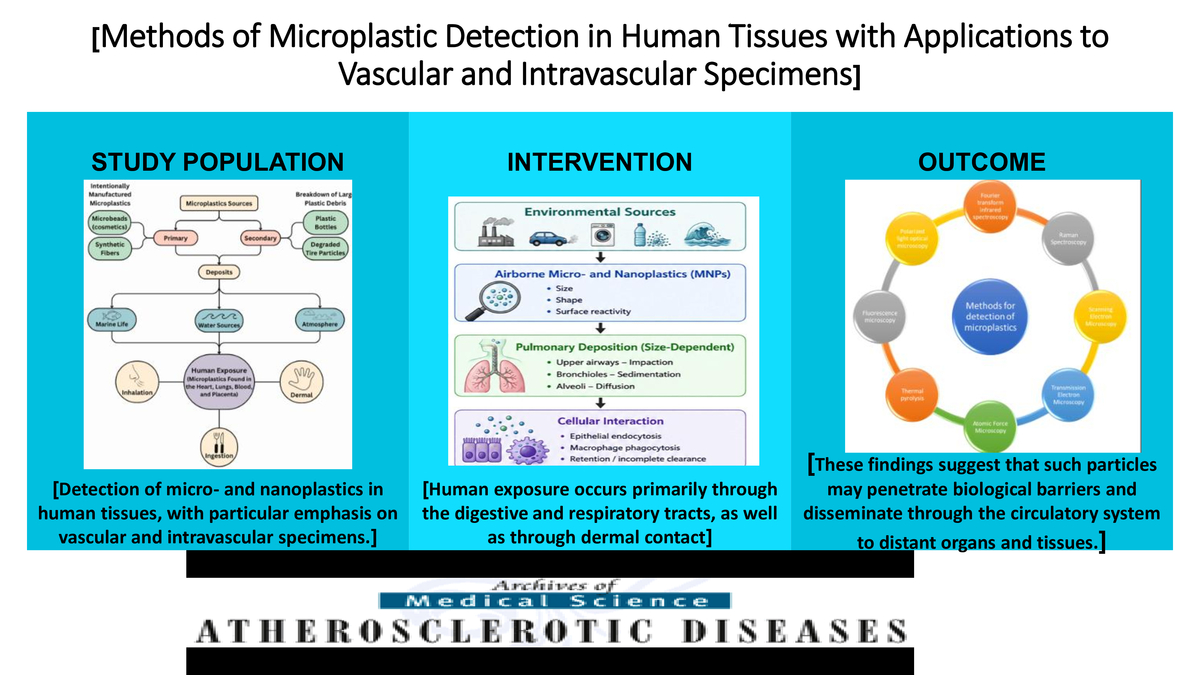
Methods for detecting microplastics in human tissues, with a focus on vascular and intravascular specimens
1
Department of Vascular Surgery, General University Hospital of Patras, Patras Medical School, Patras, Greece
2
Department of Cardiothoracic and Vascular Surgery, Westpfalz Klinikum, Kaiserslautern, Germany
3
Second Department of Surgery, Medical School, Democritus University of Thrace, Alexandroupolis, Greece
4
Department of Chemistry, University of Patras, Greece
5
School of Science and Technology, Hellenic Open University, Patras, Greece
Submission date: 2026-06-03
Final revision date: 2026-07-27
Acceptance date: 2026-08-05
Publication date: 2026-09-28
Corresponding author
Arch Med Sci Atheroscler Dis 2026;11(1):174-189
KEYWORDS
TOPICS
ABSTRACT
Due to increasing environmental contamination resulting from human activity, micro- and nanoplastics are becoming increasingly detected within human biological systems. Human exposure occurs primarily through the digestive and respiratory tracts, as well as through dermal contact. In recent years, several studies have identified micro- and nanoplastics not only at these sites of exposure but also within internal human tissues, including the liver, placenta, myocardium, blood, thrombi, and vascular specimens. These findings suggest that such particles may cross biological barriers and disseminate through the circulatory system to distant organs and tissues. At present, however, there is no standardized method for the detection and characterization of micro- and nanoplastics in human tissues. This review summarizes the currently available analytical methods used for the detection of micro- and nanoplastics in human tissues, with particular emphasis on vascular and intravascular specimens, and discusses their applicability, advantages, limitations, and methodological challenges across different biological matrices.
REFERENCES (72)
1.
Zhou G, Wu Q, Wei XF, et al. Tracing microplastics in rural drinking water in Chongqing, China: their presence and pathways from source to tap. J Hazard Mater 2023; 459: 132206.
2.
Pham DT, Kim J, Lee SH, et al. Analysis of microplastics in various foods and assessment of aggregate human exposure via food consumption in Korea. Environ Pollut 2023; 322: 121153.
3.
Wang Y, Huang J, Zhu F, Zhou S. Airborne microplastics: a review on the occurrence, migration and risks to humans. Bull Environ Contam Toxicol 2021; 107: 657-64.
4.
Wright SL, Gouin T, Koelmans A, Scheuermann L. Development of screening criteria for microplastic particles in air and atmospheric deposition: critical review and applicability towards assessing human exposure. Micropl Nanopl 2021; 1: 6.
5.
Karapanagioti H, Kalavrouziotis IK. Microplastics in Water and Wastewater. 2nd edition. IWA Book, 2020.
6.
Smith M, Love DC, Rochman CM, Neff RA. Microplastics in seafood and the implications for human health. Curr Environ Health Rep 2018; 5: 375-86.
7.
Gewert B, Plassmann MM, MacLeod M. Pathways for degradation of plastic polymers floating in the marine environment. Environ Sci Process Impacts 2015; 17: 1513-21.
8.
Dutta P, Rabeeah S, Vargas A, Oldfield EC 4th, Johnson DA. A comprehensive narrative review of potential gastrointestinal adverse effects from micro(nano) plastic exposure. Clin Gastroenterol Hepatol 2026; 24: 881-92.
9.
Jenner LC, Rotchell JM, Bennett RT, Cowen M, Tentzeris V, Sadofsky LR. Detection of microplastics in human lung tissue using µFTIR spectroscopy. Sci Total Environ 2022; 831: 154907.
10.
de Oliveira RB, Pelepenko LE, Masaro DA, et al. Effects of microplastics on the kidneys: a narrative review. Kidney Int 2024; 106: 400-7.
11.
Beyzaei Z, Geramizadeh B, Bagheri Z, Karimzadeh S, Weiskirchen R. Microplastics in focus: a silent disruptor of liver health- a systematic review. Front Pharmacol 2025; 16: 1721644.
12.
Horvatits T, Tamminga M, Liu B, et al. Microplastics detected in cirrhotic liver tissue. EBioMedicine 2022; 82: 104147.
13.
Montano L, Giorgini E, Notarstefano V, et al. Raman Microspectroscopy evidence of microplastics in human semen. Sci Total Environ 2023; 901: 165922.
14.
Kutralam-Muniasamy G, Shruti VC, Pérez-Guevara F, Roy PD. Microplastic diagnostics in humans: “The 3Ps” Progress, problems, and prospects. Sci Total Environ 2023; 856: 159164.
15.
Halfar J, Čabanová K, Vávra K, et al. Microplastics and additives in patients with preterm birth: the first evidence of their presence in both human amniotic fluid and placenta. Chemosphere 2023; 343: 140301.
16.
Ragusa A, Svelato A, Santacroce C, et al. Plasticenta: first evidence of microplastics in human placenta. Environ Int 2021; 146: 106274.
17.
Guo X, Wang L, Wang X, et al. Discovery and analysis of microplastics in human bone marrow. J Hazard Mater 2024; 477: 135266.
18.
Deng C, Zhu J, Fang Z, et al. Identification and analysis of microplastics in para-tumor and tumor of human prostate. EBioMedicine 2024; 108: 105360.
19.
Zhao J, Zhang H, Shi L, Jia Y, Sheng H. Detection and quantification of microplastics in various types of human tumor tissues. Ecotoxicol Environ Saf 2024; 283: 116818.
20.
Marfella R, Prattichizzo F, Sardu C, et al. Microplastics and nanoplastics in atheromas and cardiovascular events. N Engl J Med 2024; 390: 900-10.
21.
Wang T, Yi Z, Liu X, et al. Multimodal detection and analysis of microplastics in human thrombi from multiple anatomically distinct sites. EBioMedicine 2024; 103: 105118.
22.
Wu D, Feng Y, Wang R, et al. Pigment microparticles and microplastics found in human thrombi based on Raman spectral evidence. J Adv Res 2023; 49: 141-50.
23.
Li L, Lv X, He J, et al. Chronic exposure to polystyrene nanoplastics induces intestinal mechanical and immune barrier dysfunction in mice. Ecotoxicol Environ Saf 2024; 269: 115749.
24.
Wei W, Li Y, Lee M, et al. Anionic nanoplastic exposure induces endothelial leakiness. Nat Commun 2022; 13: 4757.
25.
Leslie HA, van Velzen MJM, Brandsma SH, Vethaak AD, Garcia-Vallejo JJ, Lamoree MH. Discovery and quantification of plastic particle pollution in human blood. Environ Int 2022; 163: 107199.
26.
Andrikopoulou C, Koletsis NE, Leivaditis V, et al. Inhaled micro- and nanoplastics as environmental modifiers of lung carcinogenesis: mechanistic insights and evidence synthesis. J Xenobiotics 2026; 16: 136.
27.
Witzig CS, Földi C, Wörle K, et al. When good intentions go bad-false positive microplastic detection caused by disposable gloves. Environ Sci Technol 2020; 54: 12164-72.
28.
Casella C, Cornelli U, Zanoni G, Moncayo P, Ramos-Guerrero L. Health risks from microplastics in intravenous infusions: evidence from Italy, Spain, and Ecuador. Toxics 2025; 13: 597.
29.
Liu S, Wang C, Yang Y, et al. Microplastics in three types of human arteries detected by pyrolysis-gas chromatography/mass spectrometry (Py-GC/MS). J Hazard Mater 2024; 469: 133855.
30.
Sarau G, Kling L, Oßmann BE, Unger AK, Vogler F, Christiansen SH. Correlative microscopy and spectroscopy workflow for microplastics. Appl Spectrosc 2020; 74: 1155-60.
31.
Schmidt R, Nachtnebel M, Dienstleder M, et al. Correlative SEM-Raman microscopy to reveal nanoplastics in complex environments. Micron 2021; 144: 103034.
32.
Yang Y, Xie E, Du Z, et al. Detection of various microplastics in patients undergoing cardiac surgery. Environ Sci Technol 2023; 57: 10911-8.
33.
Pan Y, Liu L, Luo J, et al. Micro(nano)plastics in the development of myocardial fibrosis: from clinical detection to molecular mechanism. Circ Res 2026; 138: e327073.
34.
Wang T, Li N, Zhao Z, et al. Microplastic contamination in kidney transplant donor tissues and its association with early post-transplant blood pressure changes in recipients: a multi-modal analytical study. J Hazard Mater 2025; 497: 139728.
35.
Ragusa A. Amniotic fluid and ocean water: evolutionary echoes, chemical parallels, and the infiltration of micro- and nanoplastics. Toxics 2025; 13: 776.
36.
Ragusa A, Matta M, Cristiano L, et al. Deeply in placenta: presence of microplastics in the intracellular compartment of human placentas. Int J Environ Res Public Health 2022; 19: 11593.
37.
Zoutendijk LM, Matla Z, Dusza HM, et al. Development of a reliable preprocessing protocol for fluorescent micro- and nanoplastic analysis in human placental tissue. Environ Toxicol Chem 2025; 44: 2818-31.
38.
Gao Z, Wontor K, Cizdziel JV. Labeling microplastics with fluorescent dyes for detection, recovery, and degradation experiments. Molecules 2022; 27: 7415.
39.
Erni-Cassola G, Gibson MI, Thompson RC, Christie-Oleza JA. Lost, but found with nile red: a novel method for detecting and quantifying small microplastics (1 mm to 20 µm) in environmental samples. Environ Sci Technol 2017; 51: 13641-8.
40.
Galvão LS, Ferreira RR, Fernandes EMS, et al. Analysis of selective fluorescence for the characterization of microplastic fibers: Use of a Nile Red-based analytical method to compare between natural and synthetic fibers. J Hazard Mater 2023; 443: 130217.
41.
Yang J, Zheng K, Chen W, et al. Illuminating the invisible: fluorescent probes as emerging tools for micro/nanoplastic identification. Int J Mol Sci 2025; 26: 11283.
42.
Cutroneo L, Reboa A, Besio G, et al. Microplastics in seawater: sampling strategies, laboratory methodologies, and identification techniques applied to port environment. Environ Sci Pollut Res Int 2020; 27: 8938-52. Erratum in: Environ Sci Pollut Res Int 2020; 27: 20571.
43.
Roth A, Tannert A, Ziller N, et al. Quantification of polystyrene uptake by different cell lines using fluorescence microscopy and label-free visualization of intracellular polystyrene particles by raman microspectroscopic imaging. Cells 2024; 13: 454.
44.
Lee YK, Murphy KR, Hur J. Fluorescence signatures of dissolved organic matter leached from microplastics: polymers and additives. Environ Sci Technol 2020; 54: 11905-14.
45.
Tenuta T, Monopoli MP, Kim J, et al. Elution of labile fluorescent dye from nanoparticles during biological use. PLoS One 2011; 6: e25556.
46.
Mariano S, Tacconi S, Fidaleo M, Rossi M, Dini L. Micro and nanoplastics identification: classic methods and innovative detection techniques. Front Toxicol 2021; 3: 636640.
47.
Ragusa A, De Luca C, Zucchelli E, Rinaldo D, Svelato A. Plastic, microplastic, and the inconsistency of human thought. Front Public Health 2023; 11: 1145240..
48.
Almutairi B, Kattan HF, BinMahfooz AM, et al. Synergistic effect of graphene oxide/calcium phosphate nanofiller in a dentin adhesive on its dentin bond integrity and degree of conversion. A scanning electron microscopy, energy dispersive X-ray spectroscopy, Fourier transform infrared, micro-Raman, and bond strength study. Microsc Res Tech 2021; 84: 2082-94.
49.
Akhatova F, Ishmukhametov I, Fakhrullina G, Fakhrullin R. Nanomechanical atomic force microscopy to probe cellular microplastics uptake and distribution. Int J Mol Sci 2022; 23: 806.
50.
Marrese M, Guarino V, Ambrosio L. Atomic force microscopy: a powerful tool to address scaffold design in tissue engineering. J Funct Biomater 2017; 8: 7.
51.
Li S, Li H, Li Y, et al. Photon-counting Raman spectroscopy at a MHz spectral rate for biochemical imaging of an entire organism. Nat Commun 2025; 16: 3808.
52.
Piqueras S, Duponchel L, Tauler R, de Juan A. Monitoring polymorphic transformations by using in situ Raman hyperspectral imaging and image multiset analysis. Anal Chim Acta 2014; 819: 15-25.
53.
Massardo S, Verzola D, Alberti S, et al. MicroRaman spectroscopy detects the presence of microplastics in human urine and kidney tissue. Environ Int 2024; 184: 108444.
54.
Lin PC, Lin S, Wang PC, Sridhar R. Techniques for physicochemical characterization of nanomaterials. Biotechnol Adv 2014; 32: 711-26.
55.
Käppler A, Fischer D, Oberbeckmann S, et al. Analysis of environmental microplastics by vibrational microspectroscopy: FTIR, Raman or both? Anal Bioanal Chem 2016; 408: 8377-91.
56.
Sobhani Z, Zhang X, Gibson C, Naidu R, Megharaj M, Fang C. Identification and visualisation of microplastics/nanoplastics by Raman imaging (i): down to 100 nm. Water Res 2020; 174: 115658.
57.
Imhof HK, Laforsch C, Wiesheu AC, et al. Pigments and plastic in limnetic ecosystems: a qualitative and quantitative study on microparticles of different size classes. Water Res 2016; 98: 64-74.
58.
Azari A, Ronsmans S, Vanoirbeek JAJ, Hoet PHM, Ghosh M. Challenges in Raman spectroscopy of (micro)Plastics: the interfering role of colourants. Environ Pollut 2024; 363: 125250.
59.
Garcia MA, Liu R, Nihart A, et al. Quantitation and identification of microplastics accumulation in human placental specimens using pyrolysis gas chromatography mass spectrometry. Toxicol Sci 2024; 199: 81-8.
60.
Schwabl P, Köppel S, Königshofer P, et al. Detection of various microplastics in human stool: a prospective case series. Ann Intern Med 2019; 171: 453-7.
61.
Primpke S, Godejohann M, Gerdts G. Rapid identification and quantification of microplastics in the environment by quantum cascade laser-based hyperspectral infrared chemical imaging. Environ Sci Technol 2020; 54: 15893-903.
62.
Zhu L, Zhu J, Zuo R, Xu Q, Qian Y, An L. Identification of microplastics in human placenta using laser direct infrared spectroscopy. Sci Total Environ 2023; 856: 159060.
63.
Whiting QT, O’Connor KF, Potter PM, Al-Abed SR. A high-throughput, automated technique for microplastics detection, quantification, and characterization in surface waters using laser direct infrared spectroscopy. Anal Bioanal Chem 2022; 414: 8353-64.
64.
Wohlschläger M, Versen M, Löder MGJ, Laforsch C. A promising method for fast identification of microplastic particles in environmental samples: a pilot study using fluorescence lifetime imaging microscopy. Heliyon 2024; 10: e25133.
65.
Zhang HJ, Zhou HR, Pan W, et al. Accumulation of nanoplastics in human cells as visualized and quantified by hyperspectral imaging with enhanced dark-field microscopy. Environ Int 2023; 179: 108134.
66.
Binda G, Zanetti G, Bellasi A, et al. Physicochemical and biological ageing processes of (micro)plastics in the environment: a multi-tiered study on polyethylene. Environ Sci Pollut Res Int 2023; 30: 6298-312.
67.
Karachaliou C, Sgourou A, Kakkos S, Kalavrouziotis I. Arsenic exposure promotes the emergence of cardiovascular diseases. Rev Environ Health 2021; 37: 467-86.
68.
Rios Mendoza LM, Karapanagioti HK, Ramírez-Álvarez N. Micro(nanoplastics) in the marine environment: current knowledge and gaps. Curr Opin Environ Sci Health 2018; 1: 47-51.
69.
Field DT, Green JL, Bennett R, et al. Microplastics in the surgical environment. Environ Int 2022; 170: 107630.
70.
Tarafdar A, Xie J, Gowen A, O’Higgins AC, Xu JL. Advanced optical photothermal infrared spectroscopy for comprehensive characterization of microplastics from intravenous fluid delivery systems. Sci Total Environ 2024; 929: 172648.
71.
Li P, Xu H, Li Q, et al. Micro(nano)plastics (< 4 µm): an important but ignored concern during intravenous infusion. J Hazard Mater 2025; 494: 138599.
72.
Leivaditis V, Sarafis P, Malliarou M, et al. Comprehensive analysis of natural and man-made disasters: a narrative review of causes, impacts and management strategies in Greece and the European Union. Surg Chron 2025; 30: 521-30.
Share
RELATED ARTICLE
| eISSN: | 2451-0629 |

We process personal data collected when visiting the website. The function of obtaining information about users and their behavior is carried out by voluntarily entered information in forms and saving cookies in end devices. Data, including cookies, are used to provide services, improve the user experience and to analyze the traffic in accordance with the Privacy policy. Data are also collected and processed by Google Analytics tool (more).
You can change cookies settings in your browser. Restricted use of cookies in the browser configuration may affect some functionalities of the website.
You can change cookies settings in your browser. Restricted use of cookies in the browser configuration may affect some functionalities of the website.